What Your Agency Calls "Optimization" Has A Name.
It's Testing Theater And It's Why Your CAC Hasn't Recovered Since 2022 Despite Shipping Dozens Of "Winning Ads"
We reverse-engineer what your market needs to believe before they'll buy... then deploy it across 100+ strategic ads until we find the messaging that converts and scales.
You launch 15 new ads this week.
12 of them fail immediately.
2 perform okay. Nothing special.
1 actually WINS.
Finally.
You scale it. Revenue bumps for about 30 days.
Then it dies.
Ad fatigue sets in. CPAs creep back up.
So you're back at square one.
Scrambling for the next winner.
Meanwhile, your team is burned out...
Your designers are churning through Figma files like it's their job...
(I mean, it IS their job... but you know what I mean.)
And you're stuck asking the same questions:
"Why did that ad work?"
"Can we recreate it?"
"What should we test next?"
Nobody has answers.
Just theories.
So you keep testing.
Keep spending.
Keep celebrating small wins without actually understanding them.
And the whole time...
And the worst part isn't the money.
It's not being able to explain why. To your investors. To your team. To yourself.
Testing Theater.
Your agency runs 15 new "variations" every week. Different hooks. Different headlines. Different thumbnails. A/B tests that look scientific.
But the UNDERLYING message...
Stays exactly the same.
They're not testing what your market needs to hear.
They're testing different ways to PACKAGE what they've already decided to say.
It's like rearranging deck chairs on the Titanic.
Sure, the layout looks different.
But you're still sinking.
That's not optimization.
That's the illusion of progress.
Giving you the feeling that something is being learned...
While the fundamental problems remain untouched.
And your CAC hasn't actually recovered since 2022.
Look, I know what you're thinking...
"Can't I just use ChatGPT... or one of those AI ad generators... and pump out 100 ads myself?"
Fair question.
And yeah... you CAN do that.
Here's what'll happen:
You'll generate 100 ads in an afternoon.
All of them will look decent. Some might even look great.
You'll deploy them.
And 95 of them will fail.
Not because the creative was bad.
Because they're all saying the same nothing.
See, here's what nobody tells you about generic AI tools.
They're trained on outputs. Random ads scraped from Facebook. Sales pages. Copy samples from the internet.
They learned by watching what other people already made, then got very good at producing more of it.
Which is exactly why every AI-generated ad sounds like every other AI-generated ad.
Same hooks. Same pain-agitation-solution skeleton. Same generic benefit promises wrapped in whatever emotional register you asked for.
They're aggregating existing patterns. Not finding new psychological territory.
And even if somehow you got past that...
They have zero intelligence about YOUR market specifically.
Which pains actually stop your audience mid-scroll? Which identity threats make them keep reading after the first three seconds? Which competitor failures created the specific skepticism they're carrying right now?
The AI doesn't know. It can't know. It's borrowing psychology from some other audience in some other market at some other time.
And calling it personalization.
So yeah... you can generate 100 ads.
But you're testing 100 RANDOM variations...
Instead of 100 STRATEGIC experiments.
There's a difference.
A big one.
It's not creative volume.
Both are testing dozens of ads.
It's not creative quality either.
Both have talented designers... or scary good AI.
It's STRATEGIC INTELLIGENCE.
The brands WINNING aren't debating creative decisions.
They're making DATA-INFORMED bets.
They've systematically mapped the psychological territories that drive behavior in THEIR market.
Not what prospects SAY motivates them...
What actually MOVES the needle.
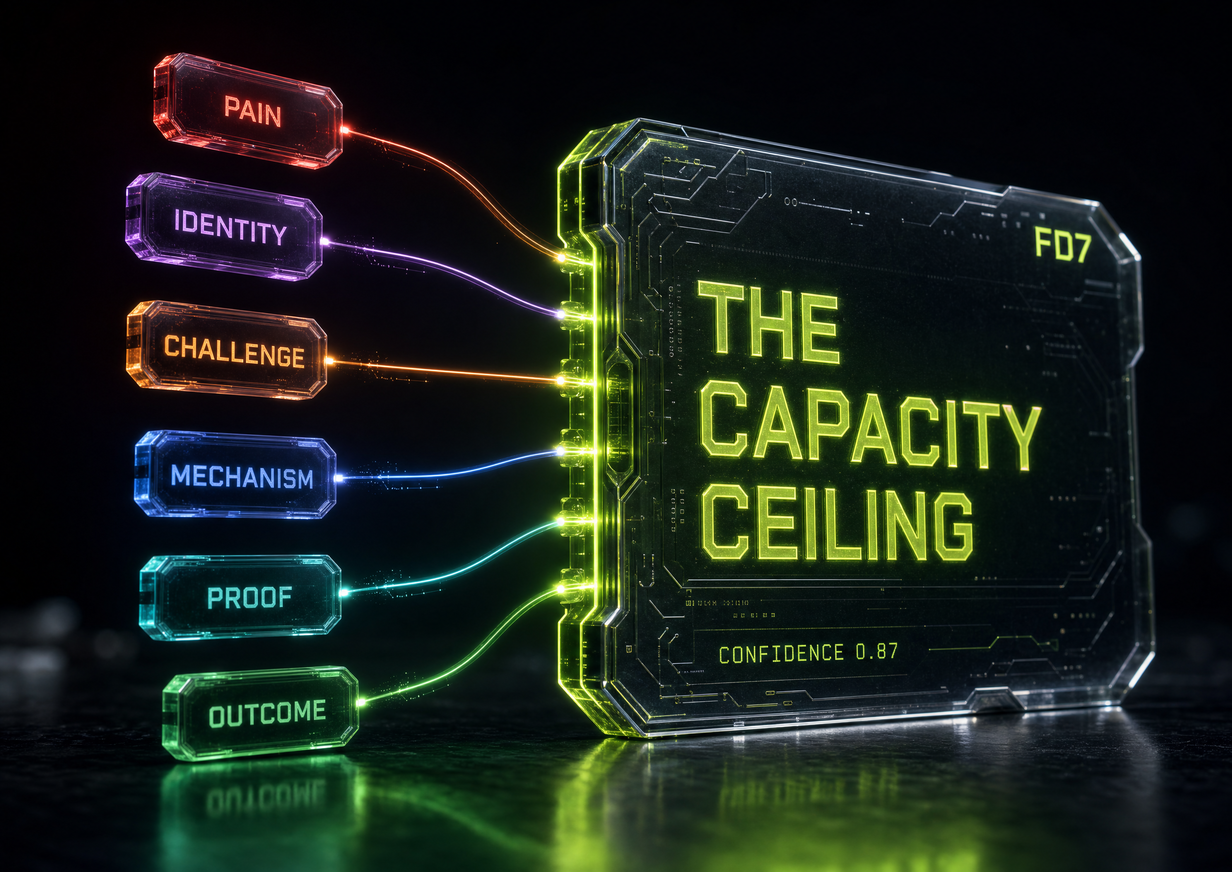
They've mapped:
→ Which pains stop the scroll dead in its tracks
→ Which identity threats keep people reading past the first 3 seconds
→ Which competitor failures poisoned the well (and how to sidestep the fallout)
→ Which obstacles prevent action... and which levers remove them instantly
→ Which outcomes actually drive purchase behavior vs which ones just sound good on paper
→ Which proof types build credibility in THEIR market... vs which ones trigger suspicion
→ Which mechanism positioning creates credibility... vs confusion and skepticism
They're not guessing.
They KNOW.
Because they've stress-tested these territories.
At scale.
With frameworks that turn creative tests into EXTRACTABLE intelligence.
Meanwhile...
The brands stuck in PLATEAU mode are playing creative roulette...
"Let's test a different hook..."
(Because surely swapping the first 3 seconds will magically fix everything.)
"Maybe we need more UGC-style content..."
(Chasing formats they saw work for someone else... with ZERO understanding of why.)
"Let's just copy what our competitors are running..."
(Thanks to Foreplay and every other ad spy tool... they're literally Ctrl+C, Ctrl+V'ing competitor ads... then wondering why they don't convert the same.)
No structure.
No system.
So they test the same territories their competitors already tested.
And wonder why they're getting the same results.
Most brands approach testing like this:
"Let's try some different angles and see what works."
Which is basically just... Throwing darts blindfolded.
Sure, you might hit SOMETHING eventually.
But you have no idea what you're aiming at.
Here's what you actually need:
A systematic framework for breaking down persuasion into its component psychological elements.
So you can test SPECIFIC hypotheses.
For example...
Instead of testing "problem-solution vs feature-benefits..."
You should be testing:
→ Does leading with "revenue stagnation" observable pain outperform "constant creative scramble"?
→ Does evoking "professional competence" identity threat create more urgency than "time anxiety"?
→ Does addressing "template systems failed before" resonate more than "agencies overpromised"?
SPECIFIC insights.
"In OUR market... revenue stagnation pain outperforms time anxiety."
"Competence threats drive more urgency than financial threats."
That's intelligence you can USE.
Not just "this ad won, cool."
To get accurate market intelligence...
You need VOLUME.
Not 10 ads. Not even 30.
You need 50. 100. Sometimes 200+.
Because your market isn't monolithic.
Different segments respond to different psychological triggers.
But producing 100 high-quality strategic ads?
Each with unique messaging?
Each with congruent creative?
That's not a weekend project.
And here's where most brands get stuck.
They know what to test in theory. But the production system required to actually run those tests at scale doesn't exist inside their organization yet.
So they either undershoot the volume (10 ads instead of 100, not enough to learn anything meaningful) or they flood the zone with surface variations that look different but test the same thing.
Same psychological territory. Different thumbnail.
That's not volume. That's the illusion of volume.
What you actually need...
Is a production system that can generate strategic messaging variations...
At the scale required to learn something meaningful...
While maintaining quality high enough that the data is VALID.
Most brands can't do this.
Most brands just look at surface metrics.
"This ad got 4% CTR. This one got 2%. Cool, scale the first one."
Done.
But they're leaving all the intelligence on the table.
Because they're not asking: WHY did that ad outperform?
Was it the specific observable pain they led with?
The identity threat they evoked?
The objection we overcame?
Without a system for ANALYZING the wins...
You're just collecting data points.
Not building INTELLIGENCE.
You can't answer strategic questions like:
"Does pain-focused messaging outperform aspiration-focused in OUR market?"
"Which specific competitor failures resonate most with our audience?"
"Which identity transformations actually drive purchase behavior?"
These are the questions that should inform EVERY decision you make.
Your ad strategy. Your email flows. Your sales calls. Your positioning.
Everything.
Four Layers That Build Permanent Intelligence
Most brands only think about the actual ads.
That's why they're stuck.
We build from the foundation up.
Most brands approach their market like archaeologists who only look at the surface.
They study what their buyers say they want. What they click on. What they buy.
But they never dig for the actual psychological structure underneath, the specific forces that explain why those behaviors happen.
That's Layer 0.
These are the building blocks of persuasion.
The irreducible psychological elements that actually drive human behavior.
Before we write a single word of copy...
We identify YOUR market's specific elements:
Observable Pains: The external, measurable problems.
Not "they're frustrated..." (that's internal).
But the actual MANIFESTATIONS:
"Revenue flat for 6 months"
"Ad fatigue hitting at 30 days"
"CPAs doubled in the last quarter"
Identity Threats: How those pains make them question WHO THEY ARE.
Professional competence: "Am I actually good at this?"
Self-worth: "Is my contribution valuable?"
Control: "Do I have agency over outcomes?"
Authenticity: "Am I being real... or playing a role?"
Challenges: The specific obstacles preventing action.
Competitor Failures: "Tried X, didn't work"
Objections: "Worried about Y with YOUR solution"
Resource Constraints: "Don't have time/money/skill"
Limiting Beliefs: "I'm not X enough"
Tangible Outcomes: Measurable, provable results your mechanism delivers.
"30% lower CPA"
"Winners lasting 4+ months"
"Systematic production process"
Identity Transformation: Who they become when the problem is solved.
Not just what they get... but who they ARE.
"Marketer who understands their market at a level competitors can't see."
"Professional with systematic creative advantage."
"Business owner who isn't constantly scrambling."
Mechanism: How your solution actually works.
What it does. How it works. Why it works when others don't.
These are your atomic elements.
And here's what most brands miss.
It's not one market. It's three.
A low-sophistication buyer is coming in fresh. They've felt the pain but haven't tried much yet. They'll respond to a direct pain-to-outcome message without needing you to explain why competitors failed.
"Revenue flat for 6 months → Here's what actually moves the needle."
Done. That works for them.
A medium-sophistication buyer has tried things. One or two other solutions that didn't deliver. They're not naive anymore. If you show up with the same "here's your problem, here's our solution" structure, they check out immediately.
For them, you have to explain why THIS is different from the thing that let them down. The mechanism has to be specific. The competitor failure has to be named.
A high-sophistication buyer has been burned enough times that their skepticism isn't really about your product at all. It's about themselves.
"I've tried everything. Maybe I'm just not able to figure this out."
That limiting belief is the actual barrier. Not awareness. Not interest. Not even credibility. For this segment, you have to deconstruct the belief before you can sell through it.
Three sophistication levels. Three completely different psychological states. Three completely different messaging architectures.
Most brands run the same creative to all three.
Then wonder why they have a ceiling.
We systematically map which elements drive behavior at each sophistication level.
So every ad we deploy is strategically calibrated.
Not to "the market."
But to a SPECIFIC psychological segment within it.
This solves Barrier 1.
Now you have a framework for WHAT to test.
Not just "try different angles..."
But systematic exploration of specific psychological elements.
A strategic positioning territory is where you combine specific psychological elements.
Add contextual state (market sophistication, awareness level, motivation direction)...
And you get a complete positioning territory.
A distinct psychological angle.
A typical product has 5-15 different territories.
Each one speaking to a different segment.
And the only way to know which territories actually work...
Is to TEST them systematically.
Not with AI pumping out random variations...
But with STRATEGIC positioning territories...
Each designed to resonate with a specific psychological profile.
A tactical messaging approach is a specific way of expressing a positioning territory.
The territory defines WHAT you're communicating.
The approach defines HOW.
You could express it through different approaches:
→ Pain-first: Lead with failures, build to mechanism
→ Identity-first: Lead with competence threat, show restoration path
→ Mechanism-first: Lead with the system, prove it works
→ Challenge-first: Lead with why templates fail, position alternative
Same territory. Different tactical entry points.
We have 14 different core copywriting structures.
Each one a different way to sequence psychological elements.
And we deploy 50-100+ approaches per engagement.
Each one a distinct tactical variation testing how to best communicate the strategic territories.
Quick aside.
You're somewhere around 2,500 words into this page right now.
Still here.
Not because the writing is beautiful. Because it's describing something you recognize.
Your market. Your problem. Your ceiling.
That's what strategic messaging does. It doesn't try to be entertaining for everyone. It speaks to one specific psychological state. And for anyone in that state... leaving feels like leaving the answer on the table.
Everyone else bounced around word 400.
You didn't.
Because this RESONATES with you.
That's the selection mechanism at work.
The people who aren't experiencing these problems left a long time ago.
The people who are... keep scrolling down.
That's exactly how strategic messaging operates. Not "engaging" for everyone. Surgically targeted to specific psychological segments.
This is the actual output.
The ad that shows up in someone's feed.
But notice where it sits... Layer 3.
Not Layer 0.
You don't START with "what creative should we make?"
You start with atomic elements.
Compose them into positioning territories.
Explore them through tactical approaches.
THEN you produce deployed ads.
Most brands do it backwards.
They start with creative. Then try to reverse-engineer strategy.
Doesn't work.
When you have the Architecture...
Creative becomes straightforward.
Because you know EXACTLY what each ad needs to accomplish.
How Intelligence Compounds Over Time
Once you have this Architecture in place...
You're not just optimizing "ads."
You're optimizing at THREE different timescales.
Which specific ads are winning?
Which platform placements?
Which creative treatments?
Standard performance marketing.
Which messaging approaches work?
Pain-first vs identity-first?
Mechanism-heavy vs outcome-heavy?
This is where you extract PATTERNS.
Not just "this ad won..."
But "THIS APPROACH to messaging works in our market."
Which psychological territories actually drive behavior?
Which elements resonate?
Which combinations convert?
This is where permanent intelligence accumulates.
You're not just finding winning ads...
You're discovering FOUNDATIONAL TRUTHS about how your market makes decisions.
Most brands only optimize Layer 3.
They look at ad performance. Pause losers. Scale winners.
That's it.
But brands with Architecture...
They're optimizing at ALL three layers.
Building a compounding intelligence advantage that gets stronger every single month.
While their competitors are still starting from scratch every 30 days.
By Building Their Market Architecture
$50K/month in ad spend. ROAS stuck at 2.8x for nine months straight.
Three agencies in two years. Each one promising the same thing: "We'll optimize your creative."
The last agency had a Figma board with 200+ ad variations. Different models. Different backgrounds. Different headline fonts. They called it "creative testing."
Every single ad said the same thing underneath.
We pulled up the creative library. Forty-seven active ads.
Every one built on the same skeleton. Product beauty shot. Three features underneath. Lifestyle model. CTA.
"Hand-finished craftsmanship." "Sustainably sourced materials." "Award-winning design."
Twelve photo shoots over eighteen months. Twelve different models. Same three talking points on a rotation.
They weren't testing creative. They were testing which photograph best delivered a message they'd already decided on three years ago.
When the element extraction came back, their head of growth stared at one finding for about thirty seconds before saying anything.
Not "premium materials."
Not "sustainable sourcing."
The finding that stopped him: his buyers weren't evaluating a product. They were reckoning with an identity.
Observable Pain: "Another cheap version cracking at the seam. Another trip to replace the same item for the third time this year."
Identity Threat: "Quietly embarrassed by how much disposable junk fills a home that's supposed to reflect who I am."
Competitor Failure: "The $90 'premium' version with five-star reviews that started peeling after three months."
Tangible Outcome: "One purchase that outlasts the cycle."
Identity Transformation: "Person who stopped replacing and started investing."
Four years of advertising. Nobody had touched the fracture line.
The real question their market was asking wasn't "Is this product worth the price?"
It was "Am I the kind of person who keeps replacing cheap things... or am I done with that?"
Three distinct sophistication segments. Three completely different psychological states.
The first group was new to the category. The pain was simple and external. A drawer full of half-broken replacements everyone pretends not to notice. Another trip to Target for the same item they bought six months ago. These buyers just needed permission to spend more than $30 on something they'd been treating as disposable.
Strategic territory: "The cycle of cheap replacements costs more than buying right once."
The second group had tried premium. Once or twice. The $90 version with five-star reviews that started peeling after three months. The $120 "lifetime warranty" brand with the customer service line that rang twelve times before someone picked up. Their skepticism wasn't theoretical. It was paid for. These buyers needed to understand WHY this would hold up when the last two "premium" purchases didn't. Not a promise. A mechanism.
Strategic territory: "Those brands charged premium prices for standard construction. Here's what actually justifies the price and why they couldn't do it."
The third group had been burned enough times that the skepticism turned inward. "Maybe I just ruin everything. Maybe cheap is what I get." This is the segment where product messaging completely fails. You can't sell through a limiting belief. You have to dissolve it first.
Strategic territory: "The problem was never your standards. It was that nothing you bought was built to meet them."
Three sophistication levels. Three completely different conversations.
Their previous agency ran the same creative across all three.
Which is why their medium and high-sophistication buyers never converted.
Eighty tactical variations in the first deployment. Each one a strategic experiment.
For the first segment: simple pain-to-outcome messaging. The cracked item in the trash can. The receipt from the third replacement this year. Then: one purchase that ends the cycle. Direct. External. No identity work needed.
For the second: mechanism-forward copy. The specific joinery technique their competitors skip because it takes 4x longer. The material sourcing decision that adds $22 to unit cost and five years to lifespan. Not "we're premium." Instead: "Here's exactly what you're paying for and why the last two brands couldn't do it."
For the third: identity copy that never mentioned the product for the first 400 words. Started with the feeling. The quiet frustration of owning things that don't hold up. The resignation that sets in after the third "premium" disappointment. Then... only after building that foundation... the reframe. And finally the product. Last, not first.
Same strategic territories. Multiple tactical entry points for each.
All systematically deployed and tracked.
Within 45 days, clear patterns emerged:
→ Low-sophistication converted best on pain-to-outcome messaging. Identity transformation didn't move the needle for this segment. They just wanted to stop replacing things.
→ Medium-sophistication needed mechanism proof. Competitor failure was the highest-resonance element by a factor of three. Every winning ad in this segment named a specific thing the competitors did wrong.
→ High-sophistication only converted on identity-first copy. Product features were invisible to this group until the limiting belief dissolved. The ads that led with permission outperformed product-first ads by 340%.
Not "this ad won."
But "here's exactly WHY it won, for which segment, and which psychological element drove it."
→ ROAS jumped from 2.8x to 4.6x in 45 days
→ CPAs dropped 38%
→ Winner lifecycle extended to 4+ months (vs 30 days before)
→ The intelligence carried over to their emails, landing pages, even customer service scripts
Not because the "creative got better."
Because every segment was finally hearing the message calibrated to their psychological state.
The new buyer got a clear reason to break the replacement cycle.
The burned buyer got mechanism proof that named what the last brands did wrong.
The skeptical buyer got permission before product.
Same product. Three entry points. That's what we build. That's what intelligence looks like in practice.
Remember the three reasons most brands can't access market intelligence?
Let me show you how we solve ALL of them.
We don't start with "let's try some different angles."
We start with systematic element extraction.
Observable pains. Identity threats. Challenges. Tangible outcomes. Mechanism positioning.
The atomic building blocks of persuasion.
Then we map which COMBINATIONS of those elements create strategic positioning territories.
(You saw this in the case study with the DTC brand.)
So instead of testing random variations...
You're testing specific psychological hypotheses.
"Does revenue stagnation pain outperform time anxiety?"
"Does competence threat drive more urgency than financial threat?"
"Which competitor failures resonate most with our audience?"
Each test answers a strategic question.
Each result builds your permanent intelligence.
Even if you KNOW what to test...
Producing 50-100+ strategic variations manually?
That's 6-12 months of work.
This is where people think generic AI solves the problem.
"I'll just use ChatGPT to pump out 100 ads!"
Sure.
But here's the difference...
Think about two chess engines:
Engine A is trained by watching millions of amateur games.
Weird openings. Blunders. Losing strategies mixed in with winning ones.
It learns by IMITATION.
Sees what people have done... copies those patterns.
Engine B is built on chess PRINCIPLES.
Piece value. Positional advantage. Tempo.
It doesn't ask "what did others do?"
It asks "what actually WINS?"
Both use AI.
But one automates mediocrity.
That's Dactyl OS.
Generic AI tools are trained on OUTPUTS.
Random ads scraped from Facebook. Sales pages. Copy samples from the internet.
They learn to IMITATE what already exists.
Which means they can only give you variations of what's already been done.
Same hooks. Same structures. Same generic promises.
Dactyl OS is built on PRINCIPLES.
The systematic framework for how persuasion actually operates.
Which elements drive behavior at different sophistication levels.
How to sequence psychological triggers.
When to lead with pain vs identity vs mechanism.
Each one designed to validate specific hypotheses about YOUR market.
That's how you get volume WITHOUT sacrificing strategic intelligence.
Most brands just look at surface metrics.
"This ad got 4% CTR. Scale it."
Done.
They never ask WHY it won.
Was it the pain we led with?
The identity threat we activated?
The way we positioned the mechanism?
Without understanding the WHY...
You can't replicate the win.
You're just hoping to stumble into another one.
We built the optimization system you saw in Section 7.
So you're not just tracking which ads win...
You're extracting PATTERNS across all three layers.
Which specific elements resonate.
Which messaging approaches work.
Which strategic territories drive behavior.
From "we found a winner" (temporary)... to "we know what wins" (permanent).
Most brands operate at the EXECUTION layer.
"Make ads. Deploy them. See what works."
We operate at the ARCHITECTURE layer.
"Map your market's psychological structure..."
"Deploy strategic experiments to validate what drives behavior..."
"Extract permanent intelligence you can use forever."
Completely different game.
And it's why our clients don't just see a short-term ROAS bump...
They build a compounding intelligence advantage that gets stronger every month.
While their competitors are still guessing at which angle to try next.
90-Day Strategic Partnership
This isn't a "done-for-you agency" where we disappear into a black box.
It's not a "coaching program" where you're left to implement alone.
Strategic partnership to build permanent market intelligence for YOUR business.
ELEMENT EXTRACTION + TERRITORY MAPPING
→ Deep diagnostic on your market using our systematic framework
→ Extraction of all relevant psychological elements (observable pains, identity threats, challenges, tangible outcomes, mechanism)
→ Definition of 5-15 strategic positioning territories
→ Validation of which territories have the highest probability of resonance
We're not writing ads yet.
We're mapping the ARCHITECTURE.
So everything we build after is built on solid strategic ground.
TACTICAL DEPLOYMENT + INTELLIGENCE EXTRACTION
→ Generation of 50-100+ strategic ad variations
→ Each testing specific hypotheses about which psychological elements drive behavior
→ Real-time tracking through our systematic framework
→ Continuous intelligence extraction showing which elements and territories actually resonate
→ Weekly syncs reviewing findings and adjusting strategy
This is where the learning happens.
Where abstract strategy meets real market feedback.
Where you discover what ACTUALLY works in YOUR market.
INTELLIGENCE CODIFICATION + SCALING
→ We identify your winning territories and scale them aggressively
→ You get the complete strategic playbook showing how persuasion operates in YOUR market
→ We train your team on deploying the intelligence across channels
→ You walk away with a SYSTEM... not just campaign results
// Plus
→ Direct access to our team throughout the engagement (not just "monthly check-ins")
→ All intelligence and frameworks become YOUR intellectual property
→ Ongoing access to Dactyl OS for continued optimization
→ You OWN the architecture we build
$48,000
Two installments: $24K upfront. $24K at day 45.
Let me be direct about what that number means.
If you're spending $30K/month on ads, you'll cross $48K in ad spend in about 50 days. That money is gone. You get campaign results. Maybe some learnings. But the intelligence stays with the agency you hired. Everything they learned about how your market actually makes decisions. Their property. Not yours.
They use it for the next client.
You start from scratch next quarter.
We charge $48K once. Everything we extract becomes your intellectual property. The psychological elements. The validated territories. The messaging playbook. Permanently. Not a monthly report. Not a dashboard we own and you rent access to.
The system. Yours.
To use on your ads. Your emails. Your sales calls. Your positioning. Every messaging decision your company makes from here forward.
Here's the actual math:
Spending $30K/month = $360K/year in ad spend.
A 30% ROAS improvement = $108K in additional revenue year one.
That's the conservative number, based on direct ad returns only.
But most of our clients see the intelligence carry across channels within 60 days. Email flows. Landing page copy. Offer framing. The psychological elements that drive purchase behavior in your market don't stop being true when someone isn't on Facebook.
The compounding effect isn't in the spreadsheet. It's real.
One more thing worth saying plainly:
Most agencies are structured to never actually solve your problem. Solve it and they lose the retainer. Our incentive is to build you something so comprehensive you could run it yourself, and occasionally you call us back when you want to add capacity.
Different business model. Different relationship.
THIS IS FOR YOU IF:
You're spending $30K+ per month on paid acquisition
You're stuck at a scaling ceiling
(usually $3-5M) and can't break through
Your current approach feels like constant creative scrambling
Winners die after 30-45 days
and you're tired of starting over
You want PERMANENT INTELLIGENCE
not just campaign results
You're willing to invest in systematic market discovery
THIS IS NOT FOR YOU IF:
You're pre-$1M still figuring out product-market fit
You're looking for a "quick fix" or need guaranteed metrics
You want someone to "just run your ads"
without strategic involvement
You think you can solve this with AI creative tools alone
You're not willing to deploy at meaningful scale
This isn't a fit you should need to be talked into. If the architecture we've described makes sense and you recognize your situation in these pages, you know whether you're ready.
Short application. Takes 5 minutes.
If it looks like a fit, we'll schedule a 45-minute strategy call.
On that call:
→ We'll dig into your current situation
→ Map out what the first 30 days would look like
→ Determine if this makes sense for both of us
If we agree it's a good fit...
We'll send the agreement.
You sign.
We start within 7 days.
"Can't I just use AI to do this myself?"
You can try.
But here's what you'd need:
First, an AI system built on psychological principles, not trained on random internet ads.
(That's what separates Dactyl OS from generic tools.)
Second, the framework for WHAT to test.
(Most people don't have a systematic way to break down persuasion into testable elements.)
Third, the production capacity to deploy at scale.
(50-100+ strategic variations, not just surface-level tweaks.)
Fourth, the analytical system to extract intelligence from the results.
(Knowing WHY something worked, not just THAT it worked.)
Most people don't have all four.
That's what you're getting here.
"What if my market is different?"
The ARCHITECTURE is universal.
Everyone has observable pains that trigger identity threats.
Everyone has challenges preventing action.
Everyone needs tangible outcomes.
What changes is the SPECIFIC content.
The exact pains. The exact threats. The exact challenges.
That's what we discover through deployment.
"How is this different from market research?"
Market research is based on what people SAY.
Surveys. Interviews. Focus groups.
We care about what people DO.
Which messages they actually respond to.
Which psychological territories drive behavior.
That's why we use deployment as the discovery mechanism.
Because behavior doesn't lie.
"Do you guarantee specific metrics?"
No. Because anyone who guarantees specific ROAS numbers in paid acquisition is either lying or has very loose definitions of what a guarantee means.
What I CAN tell you:
Every client we've worked with has seen measurable improvement.
Lower CPAs, higher ROAS, longer winner lifecycles, or all three.
But the real value isn't one metric.
It's the SYSTEM you walk away with.
The permanent intelligence that keeps working long after our engagement ends.
"What happens after 90 days?"
You own the intelligence.
You own the system.
You can run it yourself.
Or keep us involved for continuous optimization.
Your call.
We're not building a dependency relationship.
We're building YOU a permanent competitive advantage.
"Why $48K when I can hire an agency for $5K/month?"
Because agencies are selling EXECUTION.
"We'll run your ads."
Monthly retainer. Forever.
And they keep the intelligence they extract.
We're selling ARCHITECTURE.
The systematic framework for understanding your market.
The operational system for extracting intelligence.
The permanent insights that inform every decision.
One engagement.
You own the output.
Most brands spend $48K on ads in 60 days and get zero permanent intelligence from it.
We're asking for the same investment to build something that compounds forever.
The question isn't agency vs. Dactyl. The question is whether you want to rent access to intelligence you'll never fully own, or buy a system that keeps compounding after we're gone.
"What size brands do you typically work with?"
Most of our clients are doing $10M-$120M annually.
Spending $30-100K/month on paid acquisition.
They've proven product-market fit.
They have existing creative that performs... it just doesn't perform ENOUGH.
Or it stops working after 30 days.
If you're earlier stage... this probably isn't the right time.
If you're later stage... this could be exactly what unlocks your next phase of growth.
"Can I see more case studies?"
On the strategy call, absolutely.
We can walk through specific examples relevant to your market.
But we keep most client work confidential.
(Just like you'd want us to do for you.)
"Can I start with something smaller to test this out?"
Not really.
This only works at scale.
You need volume to extract meaningful intelligence.
If you're not ready to invest $48K or deploy $30K+/month in ad spend...
Then you're not ready for this yet.
Which is fine.
Come back when you are.
Market Architecture?